Web design for tradesmen who get looked up before they get rung.
Whatever it says on the side of the van, the job now begins with somebody checking you out. A name gets passed on, a search throws up four firms, and the deciding happens quietly, on a phone, before you know there was anything to decide. Web design for tradesmen is really about that stretch: what somebody finds, how fast they understand it, and whether the thing they land on belongs to you or to somebody charging you for the privilege.
Hand-coded sites for builders, roofers, joiners, electricians and plumbers anywhere in the UK, built from my studio in Prescot. £750, £1,450 or from £2,250, published, fixed, and yours outright when it is done.
What has this looked like in practice?
One trade business so far, and I would rather name it than gesture at a crowd. Darren runs Marlborough Builders in Prescot, roofing on one side and joinery on the other, three decades in, with a reputation that had never once needed a website to travel. What they had online was rented: an agency template on a monthly fee, quietly doing nothing.
He had his first enquiry within a week of the new site going live, and it now brings him three to four a week, direct through the site.
That is the whole argument for a trades website, and it is the only one that matters. Not that it looks smart. That people who did not know you existed are finding you, believing you are the right firm, and getting in touch. That is his account of his own business, not a forecast for yours. Read the full case study
Does a tradesman really need a website in 2026?
Yes, because a step has been added to the front of every job and none of us agreed to it. Somewhere between deciding to get the work done and picking up the phone, people now look. It happens for a ninety pound callout and it happens for a forty thousand pound job. It happens whether they found you on Google, saw the van on the estate, or were given your name by a colleague they trust completely.
That last one catches most trades out. A recommendation used to travel straight to a phone call. Now it travels to a search bar first, and what turns up either backs up what your customer was told or quietly undercuts it. Nobody rings to tell you they looked and thought better of it. That is the real cost of having nothing, and it is invisible, which is exactly why it goes on for years.
What is the difference between a directory profile and a website of your own?
You rent one and you own the other, and everything else follows from that. A profile lives on somebody else's platform, laid out to their template, sitting a few pixels away from four firms doing the same work as you. It is not there to get you chosen. It is there to keep the person on that platform until somebody, anybody, gets chosen. Those are not the same goal, and when they conflict it will not be your interests that win.
The rules can also change without your say so. What a lead costs, who sits above you, which badges are being sold this year, how visible your posts are to people who already followed you. And the reviews, the ones you spent five years earning, one careful job at a time, are held on a system you cannot take with you. Stop paying and the whole lot goes back behind the turnstile.
A site of your own is a different arrangement. Your domain, your pages, your photographs, and one address you can put on a van, a quote, a business card and the side of a skip, knowing it leads somewhere that is entirely about you. None of that means deleting the profiles. It means having somewhere to send people once they are interested, instead of handing them back to a page full of your competitors. I have written separately about what a fair arrangement looks like.
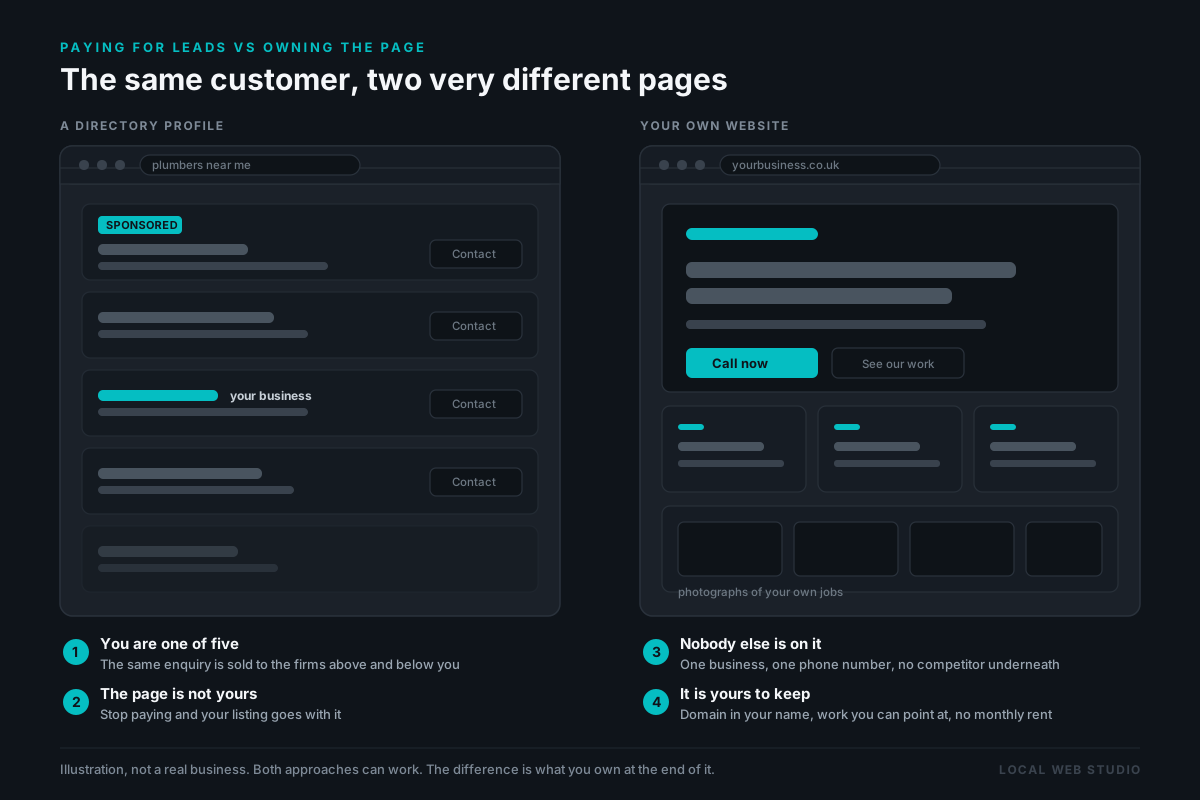
Why does paying for leads mean competing with the firm next to you?
Because the enquiry you just paid for was sold to three or four other people at the same time. That is the model, not a fault in it. The customer fills in one form, several firms are charged for the privilege of answering it, and everybody rings the same person within the hour. They did not choose you. They chose to fill in a form, and you are one of the names it produced.
Which leaves you arguing about the only thing that can still separate four strangers who all turned up at once. There is nothing on that call for anyone to weigh except the number, so the number is what gets weighed, and the firm most willing to cut it takes the job. Do that all year and you have a diary full of the work you wanted least, at the price you wanted least, paid for twice over.
Somebody arriving at your own site got there another way. They have read what you do, seen the jobs, worked out that you cover them, and decided to ring you specifically. The conversation starts from a completely different place, because by then they are not comparing four names. They are checking whether the one they picked can fit them in.
Why do most trade websites not do any of this?
Most of them are fine. That is the problem. A template with three services listed as icons and a form at the bottom is indistinguishable from every other firm in your town, so people fall back on price, which is the one comparison you do not want to win. These are the things a template cannot hold.
Pictures of work you actually did.Every trade leaves something behind, and a photograph of it is the one thing on your website that no competitor could have put there instead. A bought image decorates. A job you finished argues, and it is the rare thing on any website that a stranger has no reason to disbelieve.
The detail only you would know.The materials you specify and why. The failure you see most often on the jobs you get called out to fix. The bit of the process everybody asks about. Nobody bluffing could write any of it, which is exactly why it works on somebody deciding between you and three other names.
A patch, described as a patch.Every trade sells a radius, and most sites leave it as a vague gesture at the region. How far you go, whether distance changes the price, and where you would rather not be sent. Say it and the enquiries from an hour away stop arriving, which is worth as much as the ones that start.
One obvious way in, that you will honestly answer.Not a phone number, a form, an email address, a Messenger button and a WhatsApp link, three of which nobody is watching. Pick the route you genuinely respond on, put it where a thumb lands, and let the rest support it rather than compete with it.
Findable by the words people type, not the name above the door.Almost nobody searches for your business by name. They search for the job and the place, in that order, having no idea who you are yet. A site built around your services and your towns gets into that search. One built around a homepage saying welcome does not.
The same forty answers, written down once.Every trade has a handful of questions it fields on every first call: what it roughly costs, how soon, whether you cover them, what paperwork they end up with. Answering them on the page does two jobs at once. The wrong enquiries stop ringing, and the right ones ring already halfway to a yes.
So what do I actually build?
Every site is written from scratch for the business it belongs to. No template, no page builder, no theme bought from a marketplace and recoloured.
A service page for each thing you actually sell. A roofer who also does joinery is two different searches and needs two different pages. Putting both on one page means ranking for neither.
Location pages for the towns you work in. Real ones, with actual local detail, not the same paragraph with the place name swapped out. Google has been able to spot that for years. Mine cover Prescot, St Helens, Warrington and Widnes and Runcorn, and yours would cover wherever you genuinely work.
Your own photography, properly handled. Compressed, fast, and shown at a size where the work is actually visible. If you have not got usable photographs, that is a conversation we have early, because it is the single biggest thing that holds a build up.
Fast on a phone. Hand-coded and statically built, so it loads on a bad signal in a van, which is where a good number of your customers will first see it.
A contact form that reaches you. Straight to your inbox, with a record of every enquiry, plus click to call and WhatsApp buttons where a thumb lands.
What does a tradesman website cost, and who builds it?
| Tier | Price | Right for |
|---|---|---|
| Essentials Up to five pages | £750 | A sole trader or a small outfit with one main line of work |
| Signature Up to ten pages | £1,450 | A service page for each thing you sell, location pages, a proper gallery. The usual choice |
| Bespoke As many as the job needs | From £2,250 | Anything with booking, payments or logins behind it |
You are given one figure at the outset, in writing, and it is still that figure when the site goes live. Monthly instead, if you would rather spread it: £69 a month, £129 a month or from £199 a month, over twelve months, with no interest and no credit checks. Paying in stages instead, £100 holds your slot in the diary and the rest is split across the build, which on Essentials works out as £100 to book, £325 at design approval and £325 at launch.
There is no hourly billing on anything. Extra pages are £95 each, and anything that means building something new rather than changing something gets quoted and agreed in writing before I start it. Twelve months of managed hosting is inside every build, then it is £96 a year and stays at £96 for as long as you are with me. Care plans at £65, £95 or £150 a month cover changes, backups and ongoing search work, and they are optional: cancel with 30 days notice and the site stays exactly where it is.
Most Essentials and Signature builds go live within a week of me starting. Two to four weeks from the first conversation is the honest end to end figure, and what stretches it is almost always waiting on photographs rather than anything to do with the code.
I work on one or two of these at any given time. That is the whole model, and it is why the work looks the way it does: there is room to sit with what your business genuinely sells, which jobs you want more of and which ones you would rather stop being rung about, then build around those answers instead of dropping your logo into a layout that was finished before we met. And you are dealing with me throughout, rather than with an account manager relaying your notes to somebody you will never speak to.
You can see exactly what sits in each tier on the pricing page
Renting a website against owning one
A lot of trade website offers are subscriptions. Forty to sixty pounds a month, site included, cancel any time. For some businesses that is the right call, and the low entry cost is a real advantage. But it is worth knowing what you are buying.
At £45 a month you have paid £540 by the end of year one, £1,620 by year three and £2,700 by year five. Stop paying and the site comes down. Move to somebody else and you start again, usually without the domain.
A £1,450 build costs more in month one. Counting the £96 a year hosting that starts after the first twelve months, it comes out cheaper from month 39 onward, at £1,834 over five years against £2,700, and you own it throughout. Neither is a trick. They are different purchases and you should know which one you are making.
You can run your own numbers on the cost calculator, including whatever you are paying now or have been quoted, and the longer version of the argument is in what a website actually costs.
Where do the trades actually differ?
In what the customer is worried about, and in how long they have got to worry about it. Somebody with a burst pipe and somebody planning an extension are doing entirely different things, at entirely different speeds, and a page written to serve one of them will fail the other. That single difference decides the shape of the whole site: what goes at the top, how much reading there is, whether photographs carry the argument or paperwork does, and what a good enquiry even looks like when it arrives.
So the common ground above is where websites for tradesmen start, not where they end. Pick your trade and the argument gets specific.
Common questions
Have a question not listed here? Call or text Danny and you'll get a straight answer.
Get in touchSee the homepage before you decide anything.
Nobody should have to buy a website off a paragraph describing one, so I do not ask anybody to. If it sounds like a fit, the next thing that happens is a homepage, drawn up around your own business and sent over with nothing agreed and nothing owed: your work, your name, the places you cover, laid out the way a customer would come across them. Then you decide. Should the answer turn out to be no, you are down an hour on the phone and I am down an afternoon, which seems a fair way round.
Last updated: