Small business website design for owners with nobody to hand it to.
In a small business there is no marketing person. The website is the owner's job, queued behind the quoting, the ordering, the invoicing and the actual work, which is why it tends to get done at half ten at night or not at all. Small business website design, done properly, is mostly about taking the whole thing off that list: one price agreed before it starts, an hour of your time rather than a month of it, and something at the end that keeps working without anybody having to tend it.
Who is this for, and who is it not for?
It is for an owner who has already decided to have somebody else do it. That is the whole of the qualification. You run a small business, you want a proper website, and you would rather it was designed, written, built and finished by a person than added to your own list for another year.
There is a perfectly good alternative and it is worth saying so plainly. Wix, Squarespace and the rest will get a small business online for the cost of a monthly subscription, and for some businesses that is genuinely the right call, particularly early on when every hundred pounds is doing something else. What they ask for in return is your time, month after month, and a result that will look to anybody who has seen the template like the template it came from. If that trade suits your situation, take it. This page is written for the people it does not suit.
It is not for a business that needs a full agency either: a marketing team, a campaign to run, a content calendar and somebody to sit in a monthly meeting about it. I do not do any of that and would not pretend to.
Why is there never anybody to hand the website to?
Because in a business of one, two or five people, every job belongs to whoever has a free evening. There is no marketing department and there is no marketing person. There is an owner who is also the sales, the accounts, the scheduling and, in a bad week, the person carrying out the work, and the website is the single item on that list with no customer waiting at the other end of it. Nobody rings up asking where the website has got to. So it slips, and it keeps slipping, and two years on the business has moved and the site is still describing what it was doing in 2023.
That is also why it cannot be a project that hands you a set of controls at the end and calls it empowerment. A dashboard to log into, a blog to keep fed, software that needs updating, a theme that breaks quietly in a year: every one of those is a standing demand on somebody who has no room for another one. In a business with a marketing team those are features. Here they are jobs, and they will not get done, and the site will be worse eighteen months later than it was on the day it went live.
So it has to arrive finished. Not a platform to operate, not a starting point to build on when things quieten down, because things do not quieten down. A website that is complete on the day it launches and still accurate the following summer, whether or not anybody has touched it.
What does website design for a small business cost?
£750 for Essentials, £1,450 for Signature, and Bespoke from £2,250. Those are the numbers, and the reason they are on the page instead of behind a form is that in a small business the money is personal. It is not a line in a departmental budget that somebody signs off in a meeting they will not remember by Friday. It comes out of the same account as the stock order and the van insurance and, in a thin month, your own wages. Anybody spending from that account has an absolute right to know the figure before they spend an hour on the phone to me.
Which is why the price is agreed before anything begins and nothing is added to it afterwards. No stage payments that quietly grow, no extras discovered halfway through, no closing invoice that fails to match the opening one. A fixed number matters more here than it does anywhere else, because there is nobody above you to absorb it if it moves. If you are gathering quotes, it is worth knowing what the other routes cost.
Essentials fits a business selling one main thing to one kind of customer. Signature is where most end up once there is more than one service, or a room, a workshop or a body of work that deserves showing properly. Bespoke is for what has to be built rather than designed: bookings, payments, anything behind a login. What sits inside each one is set out on the pricing page
What I build into a small business website.
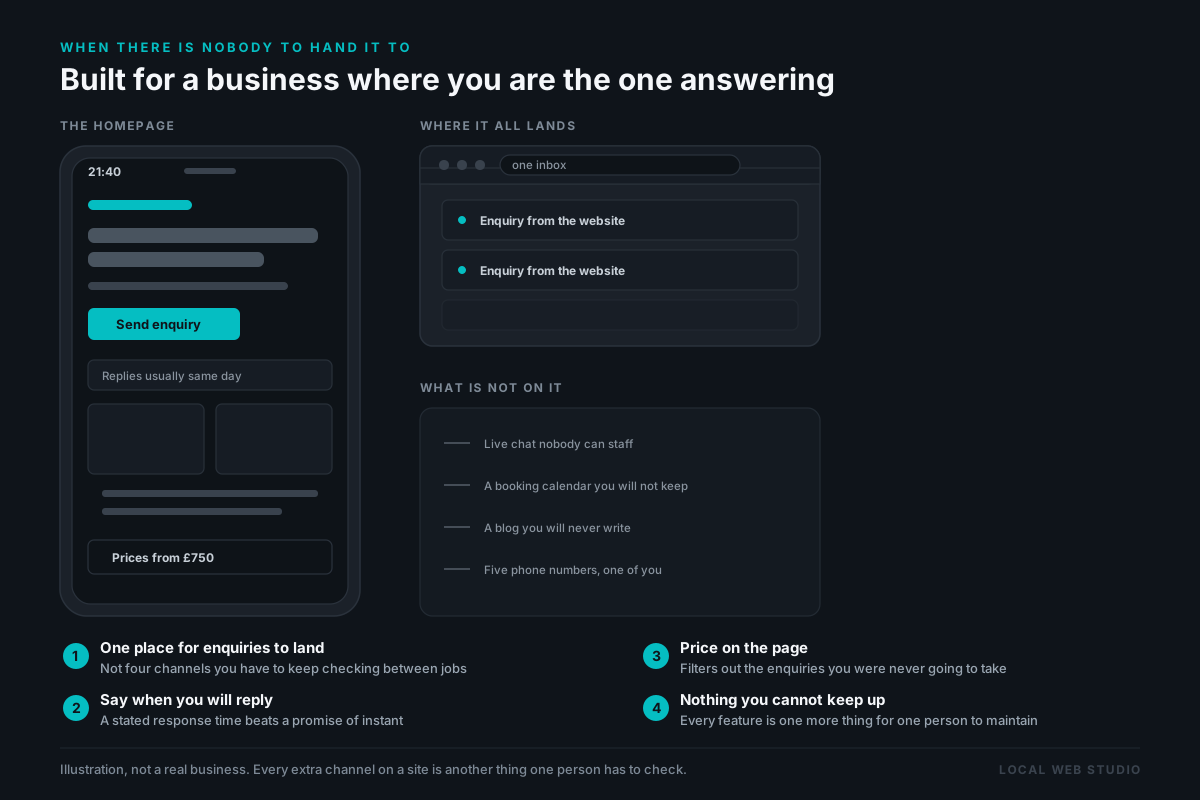
Nothing on it that needs feeding.No blog waiting for posts nobody is going to write, no plugin queue, no dashboard to remember the password for. It should still be right in eighteen months if nobody has opened it in eighteen months, because in a business this size that is exactly what will happen.
The admin handled, not forwarded to you as a list.Domain, hosting, business email, the Google Business Profile, the bits that make a site findable. Whoever gets handed that list in a small business is already doing four other jobs, so nobody gets handed it.
One thing you want more of, made obvious.Most small business sites list everything the business has ever agreed to do, weighted equally, because leaving anything off feels like turning work away. It works far better when the page is honest about the job you actually want to be rung about.
Written the way you would say it out loud.Your own sentences, tidied rather than replaced. Small businesses get sold copy borrowed from companies forty times their size, and it reads like a costume, because it is one.
A way to change one line without it becoming a project.Prices move, services get dropped, hours change for winter. You send a message and it is done that day. Nothing about a small business stays still for a year, so nothing about the site should assume it will.
Built for the phone in somebody else’s hand.Most people will meet your business on a phone, standing up, half distracted, deciding in seconds whether to bother. Fast to load, easy to read at arm’s length, and one obvious way to reach you wherever they happen to stop scrolling.
Do you only work with trades?
No. Three clients so far, and three completely different rooms. A construction firm, a treatment studio and a consultancy have almost nothing in common on the surface, and underneath they arrived with the same thing: a business people thought well of the moment they met it, and nothing online doing it justice.
Beauty, hospitality, wellbeing, professional services, retail: the job underneath is the one described above, and it varies far less between sectors than people expect. What varies is what a stranger is nervous about before they make contact, and an hour on the phone settles that quicker than any amount of guessing in advance. If you are in one of the building trades, though, the argument gets specific enough to deserve its own reading, and that is my page on web design for tradesmen
Why not go to an agency instead?
Because an agency is built around two things a small business has no use for: a retainer and an account manager. The retainer exists because there are salaries to cover between projects, so the commercial shape of the arrangement pulls towards an ongoing monthly relationship whether or not there is ongoing monthly work to justify it. The account manager exists because enough people are involved that somebody has to coordinate them, which means the person you explained your business to is not the person who ends up designing it, and what you said travels through a set of notes before it reaches anybody able to act on it.
None of that is a criticism. For a company with a marketing budget and a campaign to run, an agency is the right answer and I would say so. It is a question of shape. What a small business needs is a website built once, properly, by somebody who has heard the business described in the owner's own words rather than summarised in a brief.
I take on one or two at a time. That is a deliberate ceiling, and it pays for the rest of it: there is time to work out what a business genuinely sells before anything gets drawn, and a page can be pulled apart on the Tuesday because of something you said on the Monday.
Should the site play down how small the business is?
No, and a great many small business websites are quietly damaged by trying. You can spot it in about four seconds. Two people writing about our team and our values. A photograph of nine strangers gathered round a laptop in an office nobody in the business has ever been to. Sentences lifted from a company forty times the size. None of it makes a business look bigger. It makes it read as though it is describing somebody else, and the reader stops believing the rest of the page at the same moment.
The answer is not to apologise for the size either, which is the other common mistake and just as visible. It is to be specific. A name, a face, how many of you there are, how long you have been at it, who actually turns up on the day. Being small is why you answer your own phone, why the work is done by the person who was asked for it, and why nothing gets passed down to whoever happened to be free that week.
Said plainly, that is a stronger position than the pretence ever was, and it is the one thing a larger competitor cannot copy back at you. It is the same reason this studio is one person and says so.
What happens after the site goes live?
Nothing, unless you want something to. The site does not need daily attention, weekly posts or a person assigned to it, because there is no such person and pretending otherwise is how these end up abandoned. What is on the page is written to still be true next year, and there is nothing on it built to rot if left alone.
Then there is the ordinary business of things changing, which in a small business is constant. A price goes up, a service goes, the hours shift for winter, somebody joins. You send me a message and it is dealt with, generally the same day, and it does not turn into a project with a timeline attached. If you would rather have that arranged in advance than asked for each time, there is a care plan for it. Without one, nothing stops working and nothing expires.
Common questions
Have a question not listed here? Call or text Danny and you'll get a straight answer.
Get in touchSee the homepage before any of this becomes a decision.
The last thing you should be asked for is a commitment based on a page like this one. So there is a step before any of it gets real: I design your homepage, around your business, your name and your work, and send it over with nothing agreed and nothing owed. You look at an actual page rather than a description of one, and then you decide either way. A no costs you a phone call, which seems the right way round when the money is coming out of your own account.
Last updated: